Questions? Thoughts? Concerns? Please reach out!

The right method for producing cukes
April 6, 2026
Written by:
By green architect Peter Klapwijk
By green architect Peter Klapwijk
Before you plant cucumbers next season, ask yourself: Do you prefer simplicity and control or maximum growth? While neither answer is wrong, your preference should determine your growing method.
Today, there are two methods for growing cucumbers: the umbrella method and the high-wire method. In this article, we’re going to discuss the benefits and disadvantages of both methods and help you decide which is better for you.
Developments in cuke growing
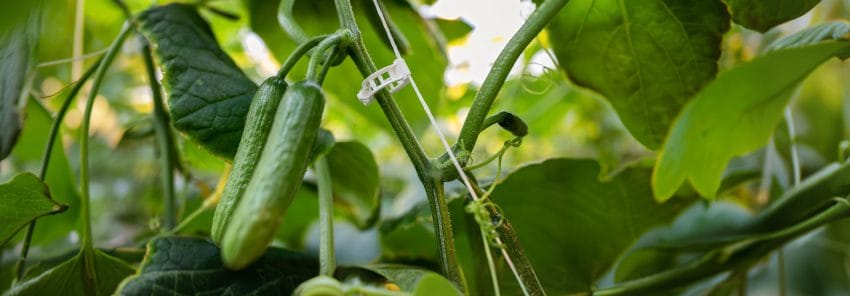
Maybe a hundred years ago, cucumbers were grown on the ground like melons. They lay in the dirt, susceptible to pests or covered by leaves blocking their sunlight. In the 1950s, with the development of greenhouses, farmers created the umbrella method in which wires were strung two meters high near the top of greenhouses. Cucumber shoots grew up a string, and when they reached the wire, two shoots would hang on opposite sides of the wire, drooping down in an umbrella shape. This kept crops off the dirt and closer to the sun. It was also more space-efficient in low-ceiling greenhouses.
In the 1990s, the high-wire system was developed for tomatoes and then quickly adopted for cucumbers. In this system, plants grow up a wire, and as the top gets longer, the farmer lowers the older part of the plant down to ensure the newer end of the shoot with crop potential stays high.
Today, many greenhouse growers are using the high-wire method, but the umbrella method still has its advantages. Let’s examine why.
The umbrella method for growing cukes
The umbrella method is a simple and effective way to grow cucumbers. In a basic greenhouse setup, where greenhouses may be lower and growers don’t want to invest in a rail tube and high-wire logistics system, this method could be the most beneficial. The setup is simple, with little equipment needed except the wires to hang the shoots over. The maintenance requires growers to prune two shoots correctly to keep enough fruit at the top of the greenhouse.
Plants hung via the umbrella method tend to thrive easily and produce a variety of cucumber sizes. Because shoots grow downward over the wire, crops at different positions along the shoot have varying access to sunlight. Crops positioned closest to the wire tend to receive more sunlight and are generally larger. Crops along the lower parts of the shoot might be smaller as leaves and higher fruit block their sunlight. This doesn’t mean that the lower crops are of poor quality, but product uniformity is not possible. Harvesting might be complicated because fruits are might be in varying positions and some might even be hidden.
Generally, with the umbrella method, farmers will plant three to four crops a year. Once plants have finished their production, the greenhouse is cleaned out and prepared for a new crop. This is one advantage of the umbrella method because it lowers disease pressure in the greenhouse, since older plants, which are more susceptible to mildew and diseases, are cleaned out. The downside of this is that farmers have a break in crop production when they wind down and set up between seasons.
Pros and cons of the umbrella method for planting cukes
| Pros | Cons |
| Simpler setup | Lower production/fewer crops |
| Better for lower greenhouses | Less uniformity |
| Lower disease pressure | Breaks in production between crops |
The umbrella method is a valid choice for growers looking for simplicity and to reduce disease pressure in their greenhouses.
The high-wire method for growing cukes
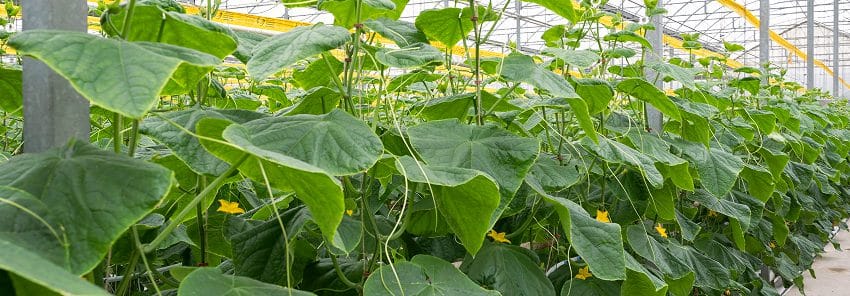
High-wire trellising is a more modern and labor-intensive method for growing cucumbers. Shoots must be clipped to wires and hung on trellising hooks that can be lowered as shoots grow. Cuke shoots can grow up to 60-70 cm per week, meaning growers likely need to lower shoots at least twice a week.
For growers with large greenhouses and a high number of crops, trellising can take a significant amount of time. However, with the right equipment, this can be done efficiently. Paskal’s Rollerhook is a state-of-the-art trellising hook that allows for rapid and safe lowering of plants. In one smooth motion, workers can steady the plant with one hand on the trellising twine and squeeze the lock with the other hand, while sliding the entire unit down the supporting overhead wire to lower the plant. In fact, in tests, workers were able to lower 36 Rollerhooks in 44 seconds while only six manual hooks could be lowered in the same timeframe. Paskal’s Rollerhooks carry 48 meters of twine, allowing for multiple crops and up to two years of use.
Another challenge with trellising is connecting the plant to the twine. Originally, growers would twist the twine around the plant, but this could lead to plant damage, and it was not very reliable. High-quality clips ensure a strong and safe connection between the shoot and the twine. Paskal has a range of clips developed to protect plants and reduce labor needed to setup a hire-wire system.
With the right equipment and the discipline and organization to lower plants as needed, growers using this method can harvest a cucumber per square meter every day. Add a growlight, and growers can harvest about 300-350 large cucumbers per square meter of greenhouse per year. Growers producing midsize or smaller cucumbers might achieve even larger numbers.
Because plants are lowered as they grow, cucumbers are always growing near the top of the greenhouse for maximum light exposure. This leads to improved crop quality and uniformity.
Pros and cons of the high-wire method for planting cukes
| Pros | Cons |
| Longer crops | Labor intensive for setup and maintenance |
| Higher crop/product uniformity | Requires higher greenhouse, rail pipe system and trolleys |
| Continuous yield | Learning curve during implementation |
Interplanting: An additional advantage of the high-wire method
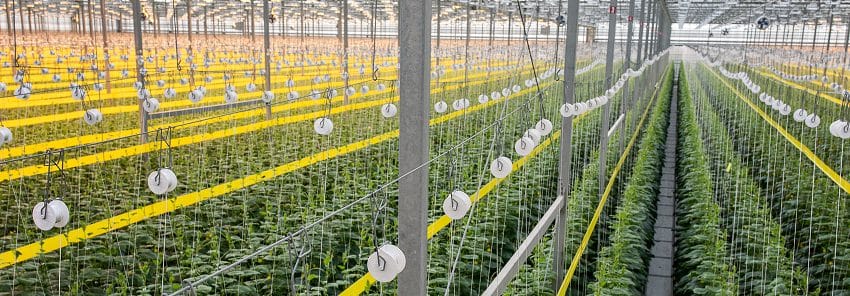
Interplanting is an effective strategy for ensuring continuous production throughout the year. With interplanting, new crops are planted in between older crops so the new crops will start producing before the older crops finish their production cycle.
Interplanting is not possible with the umbrella system, as down drooping shoots will block light and leave little room for new shoots to grow up. With the high-wire system, shoots are clipped to twine and new shoots can effectively grow upward until they are ready for trellising.
Interplanting eliminates gaps in production throughout the year. On the other hand, growers must be careful to monitor for viruses, mildew and diseases to ensure older plants do not infect newer ones.
The future of growing cucumbers
While the umbrella system is still an effective growing method, the high-wire system is the method of the future. Not only because of the higher yield and quality, but also because it is better suited for high-tech greenhouses that require structure and uniformity. For example, in the future, robots may be used to harvest, and this will be much easier if all the crops are at the same height, something that can only be achieved with the high-wire method.
If you’re not using the high-wire method, it’s time to ask yourself why. Maybe you’re happy with a basic and simple operation using the umbrella method. But if you’re looking to ensure your business’s position in the future, you need to master the high-wire system.
Please talk to us to ensure you have the equipment necessary to successfully implement a high-wire system in your greenhouse.